Delinda VanneBrightyn
Fine Art Sculpture in Glass and Bronze
HOME BIO PROCESS SCULPTURE WALL WORKS ARCHITECTURAL UPCOMING SHOWS GALLERIES
- THE ARTIST'S
PROCESS
- "I see, I dream…
light, texture, beauty, & form- dancing through space.
It presses me to exist.
I attempt to oblige."- Delinda VanneBrightyn, 2003
 Inner Page Navigation:
- Delinda's first step in creating a sculpture
(whether in glass, bronze, or ceramic) is taken by sculpting
in clay
- or wax to create an original work. The original is usually damaged or destroyed in the next steps: the mold-making process.
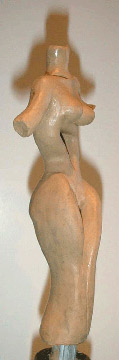
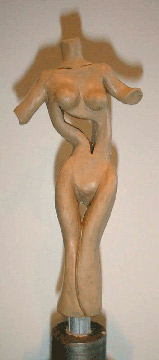
Photo #1 Right: "Transparent" (front view), from the Being Series of Delinda's works, in its first stage, a clay sculpture.
Photo #2 Right: "Transparent" (side view).
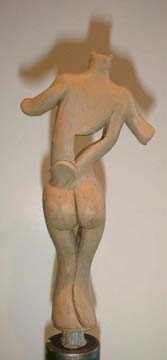
Photo #3 Right: "Transparent" (back view).
The First Mold-Making Process
- (for Glass, Bronze or Ceramic):
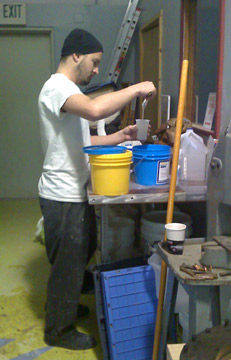
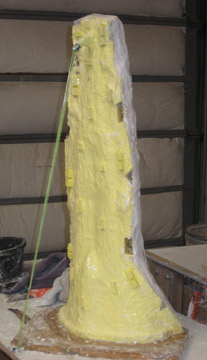
Once completed, the original is taken to Delinda's mold-making studio where: 1) She creates a rubber mold. The rubber mold can be a complex process, sometimes taking several pieces to complete the whole, 2) A "mother" mold is created to encapsulate the rubber, giving it support, 3) Hot wax is poured into the rubber/mother mold combo, creating a wax copy of the original, 4) The wax copy is cleaned and burnished to become the template for making the refractory mold into which either the bronze or the glass is cast or a mold into which the ceramic is poured or pressed.
-
- Photo #1 Left: Isaac Chavez, Delinda's studio apprentice, is mixing a batch of silicone rubber to be used on an original in the rubber mold-making process.
- Photo #2 Left: A rubber mold in process. This particular original will be later cast in bronze to become a part of a bronze and kiln-cast glass sculpture.
- Top Of Page
- Photo #1 Left: Isaac Chavez, Delinda's studio apprentice, is mixing a batch of silicone rubber to be used on an original in the rubber mold-making process.
The Kiln-Formed Glass Process:
- Delinda takes the wax copy, sprues and
vents it, and makes a mold (refractory mold) over the wax that
can withstand the heat of the glass process, but is soft enough
to remove without breaking the glass after it is cooled and rigid.
Some molds are more complex and require 2 or more parts, venting,
and/or reservoirs. Once the mold material is carefully mixed,
poured or applied in layers, and hardened, the wax is steamed
out of the mold, leaving a hollow negative space which the glass
will fill once fired in the kiln. The mold is either air-dried
for several months or force-dried in a kiln before the glass
is added and fired.
- When the mold is ready for the glass, numerous techniques may be applied in order to fill the mold: 1) pate de verre (a paste of glass) can be carefully packed in layers along the walls of the mold, 2) chunks of glass of different sizes may be strategically placed into the mold, 3) sheets, slabs or large chunks of glass can be suspended in a reservoir above the mold, or 4) the glass can be heated in a second kiln and poured in its flowing state into the mold. Delinda employees all of these techniques, depending on the sculpture and the effects she wants to achieve.
- After the mold is packed and ready to be fired, it is carefully placed into the kiln for firing. The entire firing process can take up to two or three weeks to complete (depending on the thickness of the casting) and involves several imperative steps to create a successful glass casting: 1) the mold is slowly heated and held at a specific temperature to burn off certain elements within the mold, 2) it is strategically taken up through higher and higher temperatures so the glass will flow properly into the mold, 3) it is continually raised until temperatures between 1400 and 1550 degrees Fahrenheit are reached, where the glass fully flows into the mold, 4) the kiln is very slowly cooled and held at specific temperatures on its way down to allow for flux and annealing of the glass, 5) when completely cooled to room temperature, the molded glass is finally safe to be removed from the kiln.
- The glass is then divested (the mold material is carefully removed). The cast glass is then cold-worked to achieve the artist's desired finish. Finally, the glass is prepared for mounting.
- Delinda further incorporates kiln-formed elements into some of her sculptures which are made by fusing smaller sheets of glass or frit to which Delinda has applied various techniques: painting, gold leaf, metal inclusion, enamel, mica, irrids, etc.
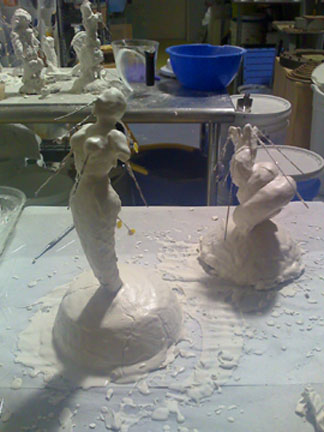
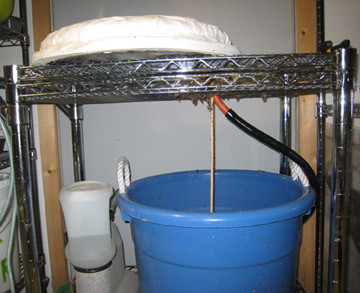
Photo Above: Refractory molds being made by applying the refractory material in a layering process.
Photo Below: The wax is being steamed out of a refractory mold at Delinda's mold-making studio, adjacent the "Artifex Gallery" in Taos.
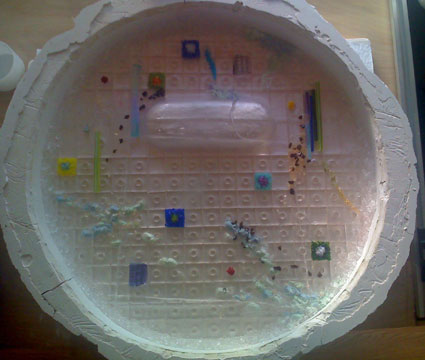
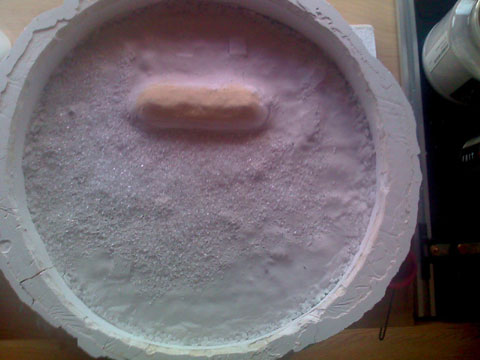
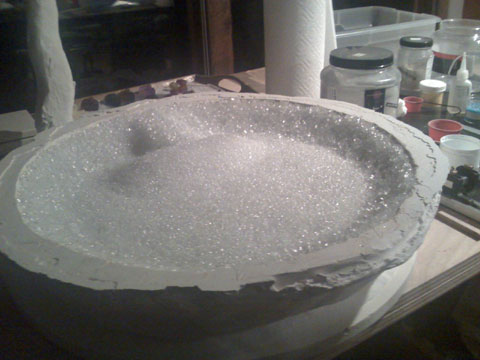
Three different stages of filling an open face mold utilizing a pate de verre technique.
The Bronze Process:
Once the wax copy is completed, Delinda takes the wax to the foundry where it is prepared with sprues, a refractory mold is made, the wax is burned out of the mold, and the molten bronze is poured into the mold. The foundry divests the cast bronze from the mold. Delinda receives the bronze from the foundry and takes it back to her studio for finishing. The bronze is "chased" (de-sprued, sanded, and blasted), finished to fit exactly to the glass, drilled and threaded for mounting, a patina is applied, and the sculpture is then assembled and mounted.
The Ceramic Process:
Once the ceramic copy is removed from the mold, it is re-finished and then air-dried to become leather ware. The leather ware is placed into a ceramic kiln and fired to the temperature appropriate for the type of clay utilized to become green ware. The green ware is removed from the kiln and a series of glazes are applied and re-fired to achieve the final color and finish of the piece. The work is removed from the kiln and prepared for assemblage with the glass elements of the sculpture.
Some of Delinda's work is entirely glass, but she loves the challenge of combining the glass with bronze, ceramics, or even silver, steel, paint and fiber to achieve a particular desired artistic statement and effect.